

I Accidentally Drank Cleaning Fluid. Here Are 8 Rules So You Don't.
A story about a water bottle, a cupholder, and the danger in how many of us store cleaning products.

I was 25, living in Boston, and my family was visiting me, which meant I was overcompensating with snacks. I borrowed the minivan to make a grocery run, climbed in, and grabbed the water bottle sitting in the cupholder. I was thirsty, I was in a hurry, and it looked exactly like a generic water bottle, filled with, you know… water.
JOKE’S ON ME! It was white vinegar. My roommate E* managed to grab the wheel as I gagged and chocked.
My dad had decanted it from the big jug in the garage before the trip (the easy, convenient thing to do) so he could use it to clean the windshield on the go.
A clean windshield was and is his yardstick by which he measures himself and everyone else.
No label. No warning. Just a very unassuming plastic water bottle in a very ordinary place, and my very reasonable assumption about what was inside it was completely wrong.
I was fine. Vinegar is not going to hurt you beyond a truly spectacular face and a solid thirty seconds of regret. We finished shopping, went home, told my parents (my family found it hilarious - jerks), and I mostly forgot about it… until I did EHS and OSHA training as a lab manager.
In a lab, I saw what the not-fine version looks like. A colleague couldn’t find the funnel, so he poured methanol into a paper cup to transfer it into a larger bottle. Just for a second. Paper cups and methanol are not friends, and neither is methanol and the inside of a human body if something had gone wrong in the transfer. I once dropped a one-gallon bottle of glacial acetic acid - it shattered on the floor, the entire building smelled like salt and vinegar chips for a week, and it melted through my shoes. Someone left powdered SDS on the balance and walked away without labeling it; someone else came along, didn’t know what it was, and swept it into the trash, where it became an inhalation hazard. I watched a person carry liquid nitrogen in a coffee thermos because it seemed easier than finding the proper Dewar.
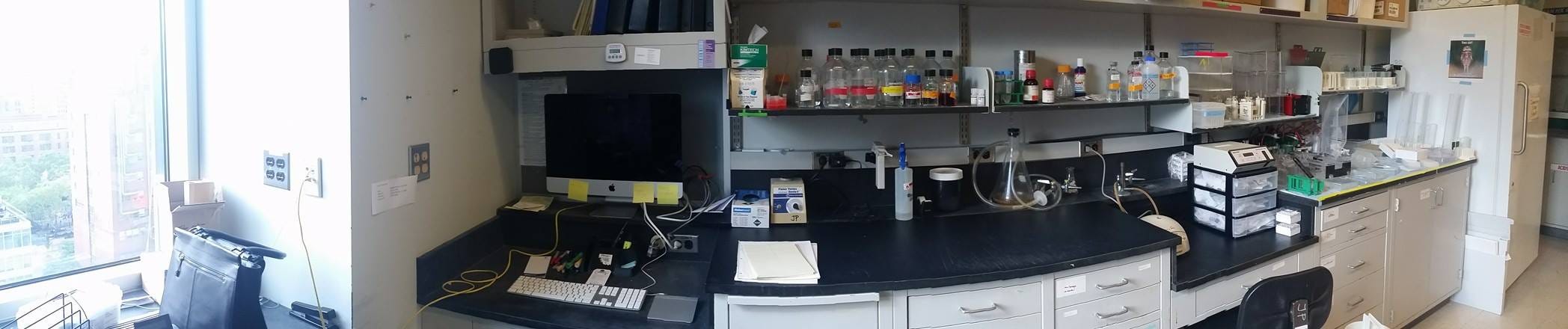
None of these people were careless. They were all smart, trained scientists who were in a hurry, improvising with what was available, and operating on the assumption that just this once would be fine. This is precisely why lab accidents happen.
It is also the way accidents happen at home. The container is different and the stakes feel lower. The logic is identical.

Most of us have a version of that vinegar bottle somewhere in our house right now. Maybe it’s a spray bottle of diluted cleaner with a faded, hand-scrawled label that no longer says what it used to say. Or doesn't say anything because of course you remember what's inside it. Maybe it’s the big jug of floor cleaner you poured into a smaller container because the original was too heavy. Maybe it’s the cleaning cabinet that’s been restacked so many times that the bleach is now sitting right next to the ammonia-based window cleaner, and no one has thought about it in years.
I’m not here to alarm you. I’m here to give you the same guide I’d hand to a new lab tech on day one, applied to the space under your kitchen sink.
Eight rules. All evidence-based. None of them require a PhD.

Rule 1: Never put a cleaning product in a food or beverage container. Ever.
This is the rule my dad broke, and it’s more common, and more dangerous, than most people realize.
A study published in Clinical Toxicology reviewed the National Poison Data System over a ten-year period and identified over 45,000 poisoning cases in the United States directly tied to products stored in secondary containers, meaning containers other than the original packaging. Cleaning products accounted for the largest share of those incidents, at 38.2% of cases, with disinfectants coming in second.1
What makes this especially jarring is the victim profile. The median age in that dataset was 30 years old. This isn’t only a toddler problem. Adults drink from unlabeled water bottles too, especially when the bottle is in a familiar location, like a cupholder or a kitchen counter, and nothing about the situation signals danger.
The American Association of Poison Control Centers documented real cases of adults drinking windshield washer fluid from an energy drink bottle, industrial cleaner from a soda can stored in a refrigerator, and pine cleaner transferred into a beverage bottle, one of which caused a small perforation of the person’s esophagus.2 The emergencies weren’t caused by ignorance. They were caused by context. The container said beverage and the brain believed it.
The fix is absolute: food containers are for food. Drink containers are for drinks. No exceptions, no matter how convenient.
Rule 2: Know the combinations that can kill you.
I say this plainly because the alternatives like “be careful” or “read the label” are not specific enough to be useful.
Mixing bleach with ammonia produces toxic chloramine gas… aka mustard gas.
Symptoms include shortness of breath, chest pain, watery eyes, throat irritation, and in serious cases, pneumonia and fluid in the lungs. The Washington State Department of Health notes that ammonia isn’t just in products labeled “ammonia.” It’s a common ingredient in glass and window cleaners, many interior and exterior paints, and it’s present in urine, which means using bleach to clean a litter box or diaper pail can create this reaction without you intentionally mixing a single thing.3
Mixing bleach with an acid, including vinegar, lemon juice, or some toilet bowl cleaners, produces chlorine gas.
Chlorine gas irritates the mucous membranes even at low concentrations and short exposures. At higher concentrations, it can be fatal. The American Association of Poison Control Centers recorded 2,284 accidental exposures to chlorine gas from bleach-acid mixing in a single year.4
Mixing hydrogen peroxide with vinegar creates peracetic acid, which is corrosive and can cause chemical burns. This one surprises people because both ingredients feel natural and gentle. They’re not gentle together.5
Write these down. Put them somewhere in your cabinet.
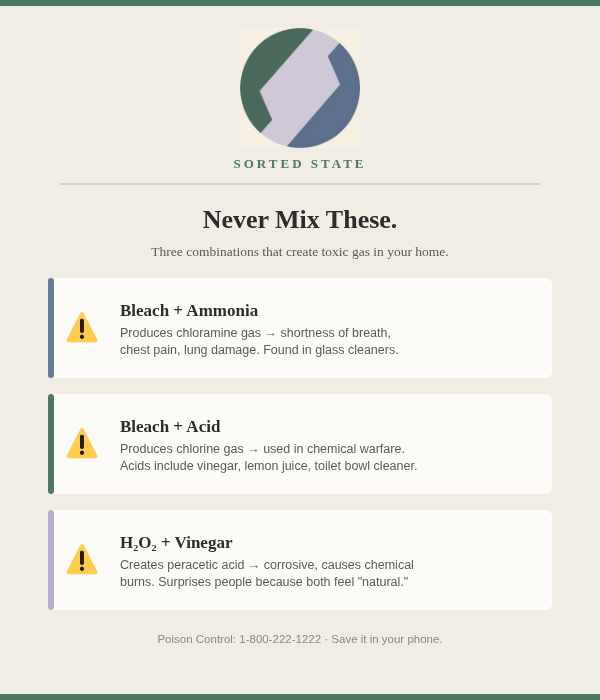
Bleach + ammonia.
Bleach + acid.
H₂O₂ + vinegar.
That’s your short list of household chemistry you are never, under any circumstances, doing at home.
You’ve just learned the two rules that prevent the most serious accidents. I didn’t feel right at all about pay-walling them. The next six are about building the system that makes those rules automatic: how to store, label, organize, and maintain your cleaning supplies so you don’t have to think about any of this in the moment.
Rules 3 through 8 (covering secondary container labeling, incompatibility storage, expiration dates, ventilation, and a childproofing framework that actually works) are available to paid subscribers below.
