

Before the Boxes
Managing a downsizing based move is hard. My mom handled it with steely determination, occasional tears, and plenty of “shit, I already packed that” moments.

A few weeks ago, I arranged a quick interview with my mom. Why? To get her viewpoint on decluttering before a move. If you’re an elder millennial, you might be living a strange kind of middle ground right now: raising little kids while helping your parents figure out what to do with a lifetime of stuff. My mom downsized two years ago.
This story is hers. And mine.

I got a bit verklempt1 when she told me she’d dismantled the photo albums.
My mom brought up the photo albums the way she tells all of the important stuff - mid-sentence, tucked between two other updates, like it was just another item on the list.
“Well, I just did another album. I told you about this project, right?” she said (or something like this… I blame baby brain for the foggy memory). ‘Well…’ the project was actually working through the twenty-plus photo albums that had lived on the shelf in the family room, above the desk in her “office.” Painstakingly, deliberately, she’d taken every photo out, sorted them, mailed some to old friends and family, tossed the duplicates, and filed the rest into labeled boxes. The disintegrating, sticky-page albums with their plastic covers, the ones with her tight cursive Sharpie notes slowly going brown with age, were gone.
I was standing near my dining table, in my apartment in California some 3000 miles away. I had a baby in the other room. And for just a moment, I felt my chest tighten.
My mom had already moved on to the next sentence. Keep calm and carry on could be engraved on our family mausoleum, if we had that sorta thing.

My mom raised five kids in a house on five acres in a small town in rural Pennsylvania, and when I say small, I mean more cows than people, two stop signs small. When my parents decided to sell the five-bedroom house and move to a smaller place on a lake, it was my mom who drove the downsizing. My dad’s health had been declining, and he wasn’t in a position to help with the sorting and deciding. Over the course of about a year, she walked through every room of the house where she’d raised her children, cared for her aging and then ailing father in the downstairs apartment, and decided, piece by piece, what to keep and what to let go.
She laughed and told me about the one year my dad helped decorate for Christmas and she redid the whole thing because it was crooked. “I guess I’m a little anal about certain things,” she said. “Packing, organizing - it kind of has to be done my way.”
Even in the hardest thing she’d ever done, her first instinct was to find the humor in it. And to take control.

She started the way you’d expect someone practical to start: she pictured the new house, measured what would fit, and worked backward. Big items first. The spare beds. A couch. End tables. “Big ticket items were easy,” she told me. “The smaller, more personal stuff probably got me a little bit more.”
Kate: Um, was there any spots in the house that you avoided or like anything that you put off to the last minute cuz you did not
Nancy: Uhhuh.
Kate: want to deal with it.
Nancy: I don’t know if it was not wanting to Well, the garage I put off because I felt like most of the stuff in there was not mine to touch. It was your dad’s. So, I didn’t want to get rid of things.
Tools, old equipment, the beer-making supplies from a hobby my dad used to share with my grandfather. She didn’t want to get rid of things that weren’t hers to let go of.
When I asked her about letting go of those things - the beer equipment, the tools, the remnants of a life - she was matter-of-fact. “I’m done with it. That’s over. And that’s okay. Somebody else can do it.”
There’s a real lesson here for anyone navigating a downsizing with a partner or family member: respect the boundary between your stuff and theirs. Even when the timeline is tight. Even when it’s frustrating. Those objects are part of someone’s identity.

Around the same time my mom was working through her house, I was preparing for my own move; consolidating from two residences in California into one house in the mountains, with a toddler and a newborn in tow. I needed to get practical about what we actually had, what we actually used, and what was just taking up space.
The previous March, my mom and Aunt came out to help visit. She and my aunt spent an evening with me sorting through all of my baby clothes, the hand-me-downs, the sentimental pieces from my own childhood, the bins I’d been slowly accumulating as my toddler outgrew items. We made tea, spread everything out, and worked through it together.
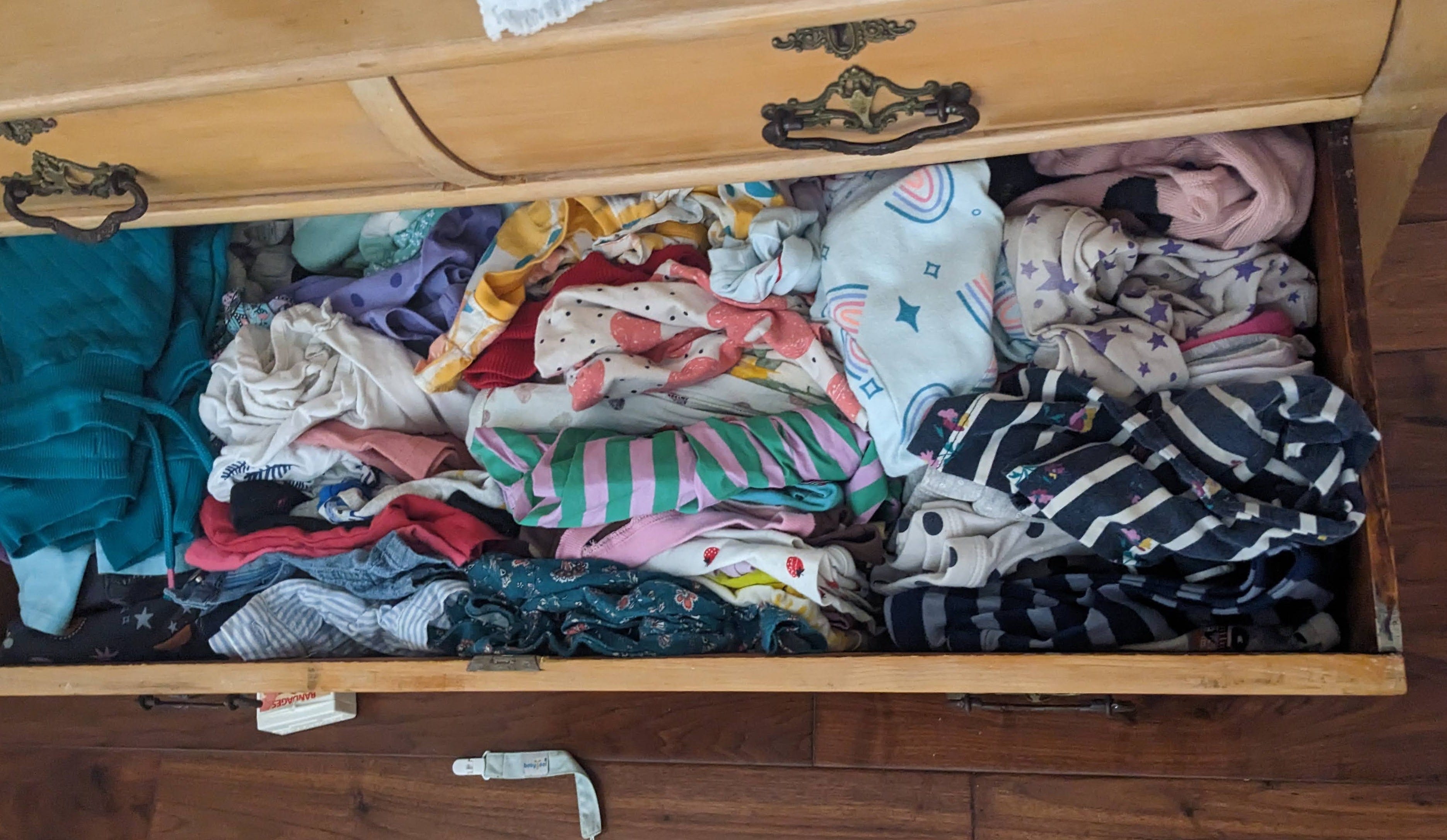
I went from six bins of hand-me-downs to three. I let go of a few things from my own childhood that I’d been keeping out of guilt more than love. There were definitely some “are you sure you want to get rid of that?” moments (just picture my mom holding up a tiny outfit, eyebrows raised) but we worked through the emotions and downsized successfully.
What made it work? We were doing it together. There was tea and conversation and laughter mixed in with the sorting. Nobody was rushing anyone. The memories got honored on the way out, not ignored. That’s the difference between decluttering and just throwing things away.

There was a Christmas a few years back, 2018, where my mom asked all five of us kids to walk through the house and put Post-it notes on the things we wanted to keep. She wasn’t preparing for anything dramatic. She just didn’t want to guess.
“I didn’t want it to be like, ‘Oh god, I got to take that now,’” she said. “I wanted to give you something you actually want. Not leave a hassle.”
My mom works at a furniture consignment shop. She sees it every week: entire dish sets, candlestick holders, Christmas decorations, sometimes even personal photos, dropped off by adult children who don’t want any of it.
“Kids don’t want stuff,” she told me. “Grandkids don’t want stuff.”
The objects you spend decades accumulating, the ones that held your holidays, your table settings, your Sunday mornings, might not mean to anyone else what they mean to you. And the most loving thing you can do is find out now, while you still have the energy to do something about it.
She told me about a Home Improvement episode2 she remembered.
Jill, the mom, gets a tea set from her mother while Jill’s sister gets the piano. Jill’s furious, she wanted the antique clock. But the mother’s memory of the teaset is different: it was from years of playing tea party together, afternoons that meant everything to her.
“Jill [the daughter] didn’t even remember,” my mom said. “She was too little.”

I wasn’t there for most of my mom’s downsizing. When she was executing the final logistics of the move, I was in California with a newborn, taping together moving boxes for my own next chapter. When my dad moved into assisted living, I was in Australia. I didn’t get the slow Saturday afternoons on the floor of the family room, sorting through memories from our shared life. I got phone calls. Updates delivered casually between other news, because that’s how my family processes hard things: quickly and without ceremony.
I’ve moved seven times as an adult. I’m extremely practical about stuff, bordering on pathological. But I’ve never had to walk through a house that held thirty years of complicated memories and decide which ones to carry forward and which ones to leave behind. Every downsizing journey is different. My mom’s was monumental. Mine was practical. Neither was wrong. But both were emotional in ways we didn’t fully expect. The stuff isn’t just stuff. It never is.


My parents’ new house is smaller, with a manageable yard, on a quiet lake in the woods.
Kate: Does it feel like it’s really yours or does it still kind of feel like the place you moved to?
Nancy: Yeah. Uh yeah,[pause]
Nancy: it still feels like the place I moved to a little, but I’m comfortable here. It’s not that I’m not um Well
Kate: Still feels like an extended vacation in someone else’s house with all your stuff?
Nancy: well, yeah, I think because you have all your stuff, that’s what makes it home.
Not the walls. Not the address. The favorite books you chose to bring, the art you hang, the objects that survived the sorting. I know this is true for me too. The first thing I do in any new place is unpack completely and get the art on the walls. It’s not decorating. I’m anchoring my identity to a new place with a few well-positioned nail holes. My mom taught me that, I think, even without telling me.
She still has one box of unsorted photo albums in the back of her closet. Hasn’t opened it since she moved in. Over two years ago. I think there’s something in that: not everything has to be processed, sorted, filed, resolved. Some things can just sit in the back of the closet and wait until you’re ready. Or not ever.
That said, the next time I get to her house, I’m pulling that box out.
Tell me about your experience with downsizing, either for yourself or for a relative. I’d love to hear from you.

The grandkids call my mom Nani. She spent a year downsizing a five-bedroom house on five acres into a two-bedroom lakefront home. This is her advice, told in her first person.
Nani’s Rules for Downsizing (From Someone Who’s Actually Done It)
Picture where you’re going, not where you are. I started by visualizing the new house - what would fit, what wouldn’t - and worked backward. It made the big decisions almost automatic.
Decluttering and packing are two different timelines. Start sorting and letting go early, but hold off on the actual boxing up. I started packing too soon and spent months moving sealed boxes from room to garage and back again, digging through them to find things I still needed. It added stress rather than making me relax. Declutter first. Pack later than you think.
Big stuff is easy. Small stuff is where it gets you. Beds, couches, end tables, those decisions took minutes. The kids’ things, the sentimental items, the “maybe someone will want this someday” pile, that’s where the real time goes. Give yourself permission for that to take longer.
Have more than one exit route for your stuff. I used a free sign on a busy road (things vanished fast), the consignment shop where I work, direct offers to family, and donation drop-offs. Having multiple outlets meant nothing sat in limbo.
Ask your family what they want. Now, not later. One Christmas, I asked all five of my kids to walk through the house and put Post-it notes on the things they wanted to keep. Even though not everyone agreed with my process, I got real answers, and some of those answers have already changed. Which is exactly why you ask early!
Don’t touch what isn’t yours to touch. I left the garage until the very end because most of what was in there was [Rick] my husband’s. Even when the timeline is tight, respect the boundary. That stuff is part of his identity, not mine.
Think twice before you dismantle the photo albums. I sorted twenty-plus albums into neatly labeled boxes and I’m almost sorry I did it. Not because the photos are gone; they’re all still there, organized by year. But people liked flipping through the albums. The album made it accessible and shareable. That was part of the memory, not just the container for it.
-Nani
As a footnote: A few years ago, the book The Gentle Art of Swedish Death Cleaning by Margareta Magnusson became quite popular. I read it, and I assure you, it gives very practical advice from a no-nonsense Swedish woman on how much it can be a burden to leave your children or family with a household of items after your death. If you’re interested in this topic, pick it up at your local library!

For my paid subscribers: the “One Drawer” Discovery
