

Four Rights Make a Left
What my obsession with avoiding left turns taught me about the efficiency of going the long way around.

My grocery store is six minutes from my house. One left turn, at a red light. Simple.
Coming home is a different story. Instead of turning left out of the parking lot onto the busy road, I drive to the far side of the lot, exit from the other end, and make four consecutive right turns to loop myself back onto the same road, now heading in the right direction. It adds two, maybe three minutes to what is otherwise a ten-minute round trip. That’s a 50% increase in travel time for a bag of groceries and a pack of diapers.
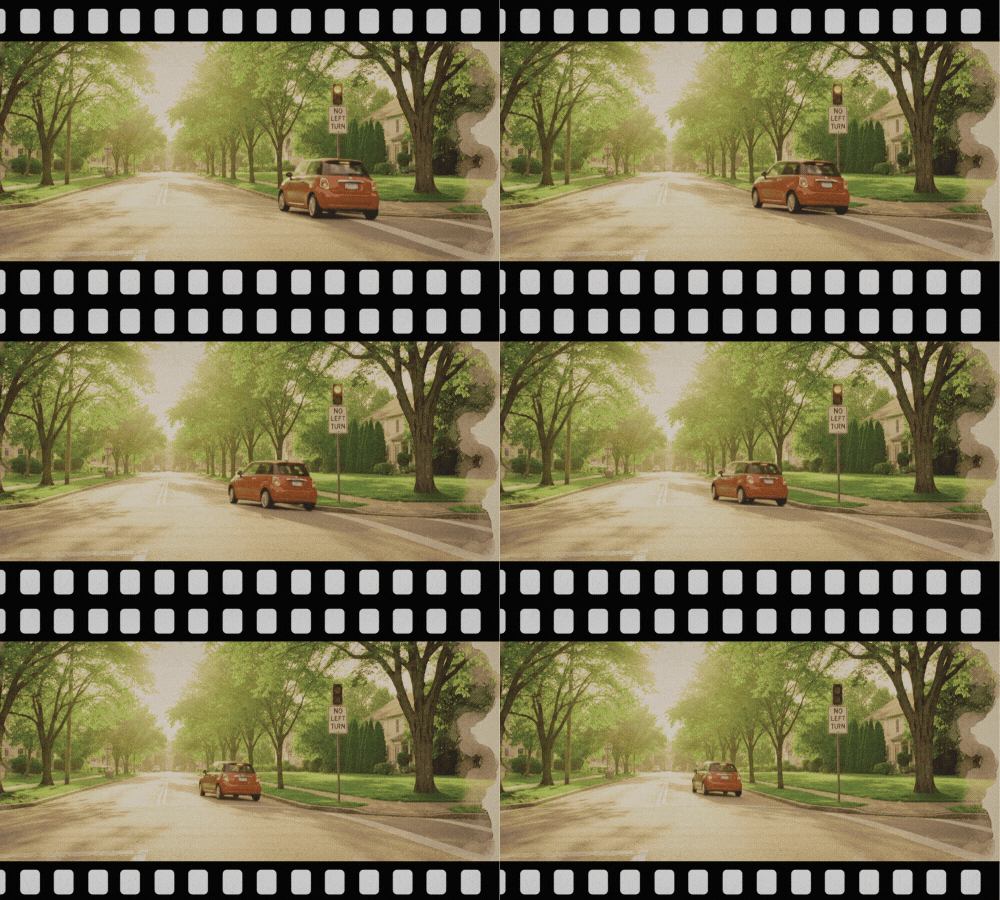
And I do this every single time. Even on a quiet Saturday morning, even when there’s barely a car on the road, even when my kids aren’t in the backseat. Especially when my kids aren’t in the backseat, actually, because Saturday morning, alone, groceries done, coffee in hand - that’s exactly when you let your guard down. That’s when you stop paying attention. That’s when you make the mistake.

I know how this sounds. My husband knows how this sounds. He has, over the years, developed a policy of simply not commenting on my driving decisions, which is generous of him, given that when he’s behind the wheel I am absolutely the worst kind of backseat driver. Constantly course-correcting. Narrating alternative routes. He once told me he’d rather just let me drive than listen to me navigate, which, fair.
The left-turn thing didn’t start as a philosophy; it started with a whisper, not a bang.
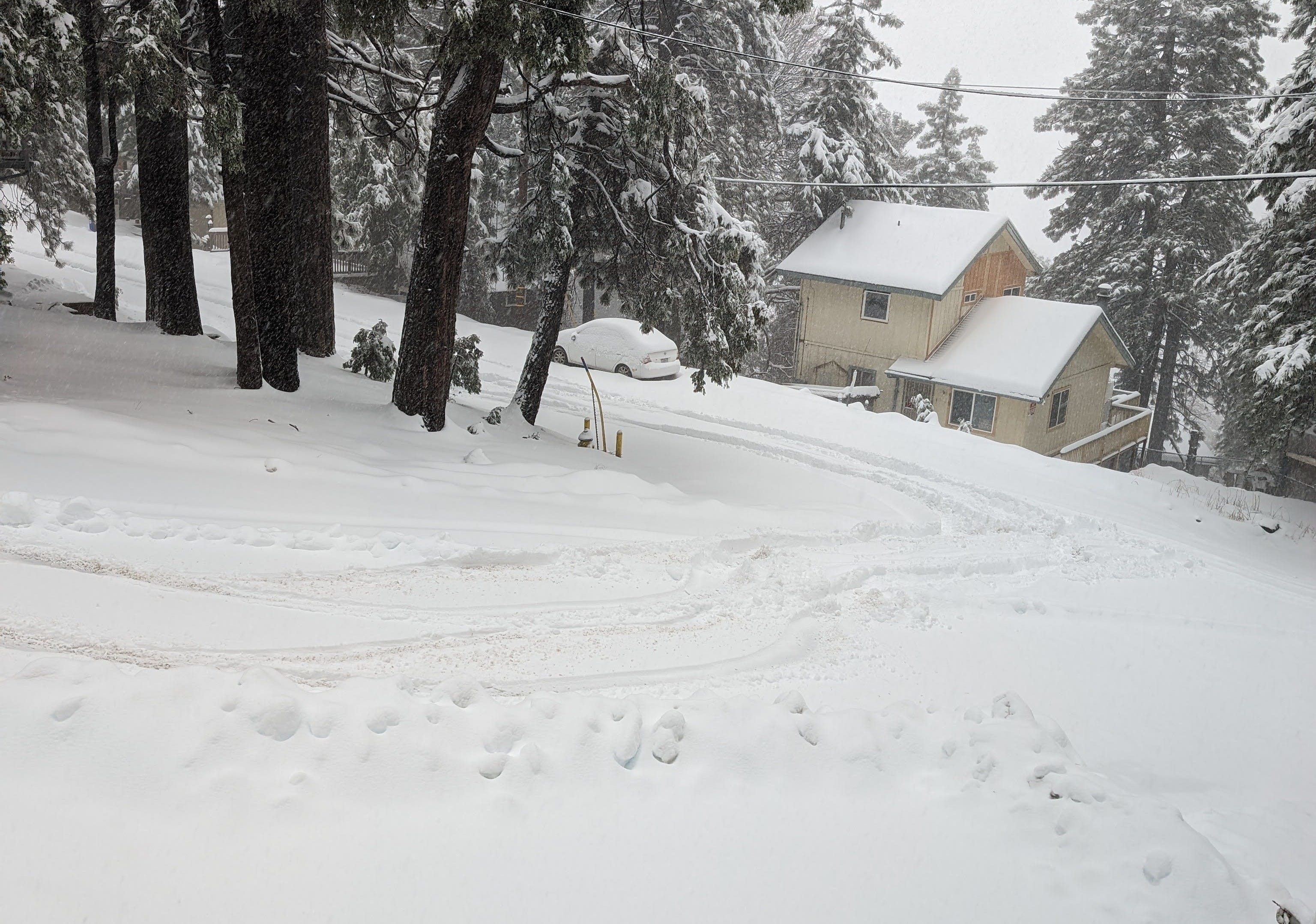
In 2024, we were living in Running Springs, California, up in the San Bernardino Mountains. At the top of our road, there was an intersection where you had to turn left to get to the ‘big’ grocery store in Lake Arrowhead. Busy road. Fast traffic. Limited line of sight. One afternoon I pulled out, misjudged a gap, and narrowly avoided a collision. I was lucky enough to be in a car with fast acceleration, and I floored it through the turn with my heart in my throat and my daughter in the backseat.
I never took that left again. I found a different route: loop through town, duck under an overpass, come up the other side of the highway, and merge with a right turn. It added time. I didn’t care. I had done the math in my head, the math that isn’t really math but is the kind of risk calculus your body does for you when your heart is thumping and your hands are still shaking on the steering wheel.

But here’s the thing: the math actually is math.
According to the National Highway Traffic Safety Administration, left turns are the critical pre-crash event in 22.2% of all collisions. More than 53% of cross-path crashes (the ones where you’re cutting across oncoming traffic) involve left turns. When you compare intersection collisions involving turning, over 60% involve left turns. Right turns? Three percent.12
And the type of crash matters. A left turn gone wrong is a side-impact collision, a T-bone, where there are only a few inches of door panel between you and the other car. Vehicles involved in side-impact crashes see fatalities at speeds as low as 31 mph, compared to around 43 mph for frontal impacts.3 The side of your car is, structurally, the least protected part of the vehicle you’re sitting in. If the thing hitting you is an SUV or a truck (and these days, it probably is), the mismatch in size and height means their front end can bypass your crumple zones entirely and intrude straight into the passenger cabin.4
So when I reroute around a left turn, I’m not adding two minutes. I’m trading two minutes for a meaningfully lower chance of the worst-case scenario. It’s not anxiety. It’s a risk calculation. And, as it turns out, I’m not the only one running it.
Back around 2015, when I was first studying LEAN and process improvement, my uncle mentioned something that stuck with me: UPS trucks almost never turn left.5
This sounded, at first, completely absurd. But UPS had figured out that left turns were dragging down efficiency across their entire fleet. Drivers idling at intersections, waiting for gaps in oncoming traffic, burning fuel, running up the clock, getting into accidents. So they redesigned their routes around right-hand loops, and they built software (called ORION) to optimize for it at scale. The results are staggering: roughly 90% of UPS turns are now right turns. The policy saves an estimated 10 million gallons of fuel per year, cuts 20,000 tonnes of carbon emissions, and delivers 350,000 more packages annually, all while reducing total distance by 28.5 million miles. Despite the individual routes being longer.

Read that again: the routes are longer, and the system is more efficient.
There’s a concept in operations called intentional friction.
It’s the deliberate choice to make a process slower, harder, or less direct, because the thing you’re optimizing for isn’t speed. It’s safety. Or quality. Or accuracy. Or the avoidance of a catastrophic failure that would cost you far more than the extra minutes you’re spending now.
It looks like inefficiency if you’re only measuring one variable. But if you zoom out and ask what are we actually optimizing for, it’s the opposite.
I used to be terrible at this in one, very specific way. (And potentially very damaging.) At work, for years, I sent emails the moment I finished typing them. High-stakes communications, emotionally charged responses, complex requests to senior leadership; I would word-vomit into the compose window and hit send like it was a reflex. And then I’d sit there, watching my inbox, regretting approximately 40% of what I’d written.
It took a manager I trusted, and later an executive coach, to help me see that the problem wasn’t my writing. It was the absence of friction. There was nothing between the impulse and the action. No gap. No pause. No turn signal, if you will.
So I built friction into the process. For high-stakes emails, I stopped putting anyone in the “To” line except myself (eliminating the risk of a premature send). I started using “Schedule Send” set for two hours out, so I could call a colleague, pull up the draft on a screenshare, and read it aloud before it went anywhere. And if the email was emotionally charged, I gave myself a hard 24-hour cooling period. The draft sat in my inbox overnight. Usually, by the next morning, I’d rewrite half of it.
Each of these steps made the process of sending an email slower. Less efficient, on paper. But the number of oh, I wish I hadn’t sent that moments dropped to nearly zero. The friction wasn’t a bug. It was the fix.
I’ve been thinking about where else this logic applies. The five seconds it takes to put your phone in the console before you start driving. The extra minute of re-reading a text before you send it to your ex. The walk around the block before you respond to your kid’s tantrum. The decision to buy the slightly more expensive, slightly less convenient option because the cheap one has a failure mode you can’t afford (ahem, new roof).
Tell us in the comments - have you implemented any moments of intentional friction? What’s worked, what hasn’t?
We’re trained to believe that faster is better, that the shortest route is the smartest route, that removing steps from a process is always an improvement. And sometimes it is. But sometimes the most important thing you can add to a system is a pause. A loop. A reason to slow down and check your mirrors.
This Saturday, I’ll load my grocery bags into the car, pull my seatbelt across my chest, and drive to the far side of the parking lot. I’ll make my four right turns. I’ll add my two minutes. And I’ll merge onto the road heading home, with traffic, no gap to judge, no oncoming headlights to calculate against.
The long way around is not the wrong way around. Sometimes it’s just the way*.
-Kate
*…(This is the way)
National Highway and Transportation Safety Administration, Department of Transportation. September 2010, DOT HS 811 366 https://crashstats.nhtsa.dot.gov/Api/Public/ViewPublication/811366
Left Turn Facts and Figures, October 13, 2023 by Levinson and Stefani https://levinsonstefani.com/left-turn-facts-and-figures/
Wikipedia, Side Collision https://en.wikipedia.org/wiki/Side_collision
Crandall CS. Driver mortality in paired side impact collisions due to incompatible vehicle types. Annu Proc Assoc Adv Automot Med. 2003;47:495-506. PMID: 12941243; PMCID: PMC3217542. https://pmc.ncbi.nlm.nih.gov/articles/PMC3217542/
Ever Notice That UPS Trucks Rarely Make Left Turns?, Harvard Business Review, April 2014 https://hbr.org/2014/04/ever-notice-that-ups-trucks-rarely-make-left-turns
This is the way.
That made me smile.
Decades ago I had a dream. I could go up the mountain following the really long path with the gentle, easy slope. Or I could take the more hazardous, but direct route which involved steep steps and maybe some climbing. I woke up realising that it didn't matter which path I followed to my destination. Sometimes in life it's necessary to hurry and take the shortcut, but mostly it's okay to take my time, enjoy the view and go the long way around.
I love love love this comment. Thank you!
You are so right - the journey can look different and that's okay. It's important that we recognize not everyone's path looks the same.