

The Last 🤬 Roll
Did I need 6 months of toilet paper to understand the lie of bulk buy?

The day we rocked up*1 to our new house straight from Perth -> Singapore -> Newark, I took an Uber to the car rental place, picked up a minivan, and drove straight to Costco. We’d been traveling for over 30 hours, we had 12 suitcases and parcels that had come with us from Australia, and our moving company had already delivered our furniture to our new home. I had no idea what shape anything was in (I’m looking at you, broken bed frame…) But I knew we didn’t have toilet paper ,or many other basic items.
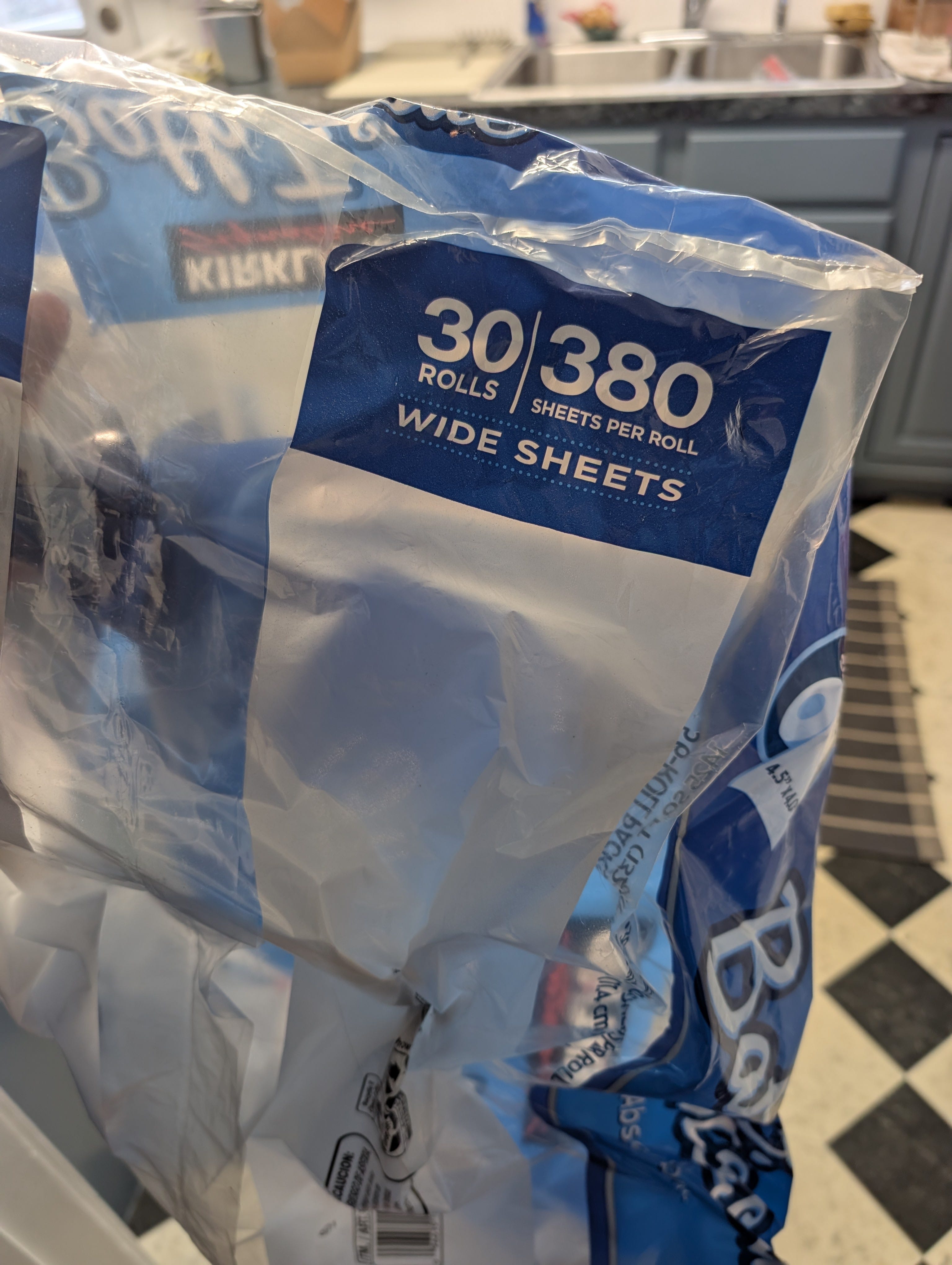
I was jet-lagged almost, but not quite, to the point of being a danger to myself and others and I did NOT want to make a second stop, even if I love and missed Wegmans beyond a reasonable amount. So when I got to the paper products aisle, I did the thing I never do: I grabbed the massive Costco pack. The one that comes in a bag the size of a sleeping toddler.

I regretted it almost immediately.
The roll didn’t fit the toilet paper holder. It was too round, too fat, like trying to shove a grapefruit into a coffee mug. So I set it on the windowsill. And there it sat, in all its linty, too-squishy glory, slowly shrinking over the next few weeks until it was finally small enough to wedge onto the holder. I did this cycle maybe three or four times before I gave up entirely. The windowsill became the toilet paper’s home. A monument to my one moment of weakness at Costco.
The worst part was the bag. Actually, the bag of bags…
Every damn time I opened the hallway cupboard, there it was, because OF COURSE the bag is too big to fit in my bathroom cupboard. Getting incrementally smaller, two rolls at a time, and my brain would do this thing, every damn time, which is to count them. How many rolls left? How many weeks does that represent? Do I need to add toilet paper to any list yet? I was running passive inventory management on toilet paper, and I did not sign up to do that shit. (Read Ticker Tape brain. I got enough to manage already.)
The Ticker Tape

We bought our forever home in November, and within two weeks we noticed the second floor just wasn’t warm.
I know this sounds ridiculous. It is ridiculous. But that’s exactly the point. I hated this toilet paper. It was linty. It was squishy in a way that felt like it was trying too hard. Every time I used it, I groaned internally, because there was still so much left. I was trapped in a consumption cycle of my own making, suffering through finishing a product I didn’t even like, because throwing away perfectly functional toilet paper felt like I was being an ungrateful brat.
Like, what a first world problem you have, Kate.
You’re complaining about your toilet paper?
Next thing, you’ll start complaining about the fresh, running water you have!
To protect my sanity, I did some quick number crunching. I did a complex historical analysis and calculated our household’s rate of consumption. (We are a bidet family. IYKYK.) Then, using all of the skills I’ve learned from years of working in a lab, I figured out the projected depletion date, and set a calendar reminder for myself. Finally, I could stop doing mental gymnastics every time I opened the cupboard.
(I was bang on, by the way. The reminder popped up over the weekend, and I had exactly one roll left. My forecasting model worked. I’m choosing to feel proud about this rather than examine what it says about me.)
Last week, I went to my regular grocery store and bought a six-pack. Normal-sized rolls. They fit the holder. They’ll last about a month. And when I put them in the tiny cupboard above the toilet, I felt something I can only describe as a small, private liberation. The bag was gone. The counting was over. The windowsill was just a windowsill again.

The ghost of toilet paper past
In March 2020, as COVID-19 lockdowns swept across the country, toilet paper was one of the first things to disappear from store shelves. Not because there was a supply problem (there wasn’t), but because everyone did the same thing at the same time: bought more than they needed, just in case.
The psychology of that moment warrants more than a single line in this story. The pandemic made us feel wildly out of control, and buying things (tangible, holdable, stackable things) was one of the few actions that felt like agency. Toilet paper became the symbol not because it was scarce, but because it was visible. An empty shelf where something should be is more alarming than almost any statistic. And the stockpiling itself created the very shortage people feared, a self-fulfilling prophecy, one Costco run at a time.

The panic buying wasn’t really about the product. It was about the feeling; people were buying certainty. They were buying the sensation of being prepared, of having done something in a situation where nothing felt doable. And the cost was just as much cognitive as financial. Suddenly everyone was managing a household inventory they’d never had to think about before, tracking supplies, rationing, calculating burn rates on paper towels. The mental load of excess, arriving uninvited, at the worst possible time.
We’re seeing echoes of this right now. In Japan, consumers recently started stockpiling toilet paper in response to oil market disruptions, despite toilet paper having essentially nothing to do with oil supply chains2. Here in the U.S., the Washington Post has been telling Americans not to stockpile toilet paper in response to tariff anxiety.3 Importers are sitting on 18 to 24 months of supply instead of the 6 months they planned for.4 A survey found that 34% of Americans are stockpiling essentials, with toilet paper at the top of the list.5
The instinct scales from a single person in a Costco aisle to an entire nation’s supply chain, and the mechanics are identical. I don’t want to think about this later, so I’ll just buy extra now. But “extra” has a cost, whether you’re a jet-lagged mom with a bag that won’t fit in the cupboard, or an entire country with warehouses full of goods that no longer make economic sense to sell.

The carrying cost of convenience
The savings of buying in bulk aren’t free. You pay for them in other ways. You pay in storage space. You pay in the mental load of tracking inventory you never asked to manage. You pay in the slow, low-grade irritation of using a product you don’t love because you bought too much of it and now you’re committed. In manufacturing operations, we call this “carrying cost,” the ongoing expense of holding inventory. Warehouses pay it in rent and refrigeration and insurance. You pay it in cupboard space and cognitive bandwidth and the vague annoyance of seeing that bag every single morning.
The math of bulk buying looks great in the Costco aisle. You’re comparing unit price (lower!) and imagining a future where you never have to think about this product again. But that’s the illusion. You will think about it. You’ll think about it every time you open the cupboard. You’ll think about it every time the roll doesn’t fit the holder. You’ll think about it when you do the mental arithmetic of how much longer instead of just buying what you need, when you need it.
Toyota pioneered Just-In-Time (JIT) manufacturing in the mid-20th century, and the basic idea: don’t stockpile materials. Instead, get or produce what you or your customers need, right when you/they need it, in the quantity you/they are ready for. The opposite of JIT is “just in case” purchasing, which is what I did at Costco that day. I bought toilet paper just in case, because I was exhausted and starting from zero and didn’t want to have to think about it later. But “not thinking about it later” turned into thinking about it constantly for six months.
JIT works because excess inventory isn’t neutral. It doesn’t just sit there being cost-effective. It takes up space. It obscures what you actually need. It creates its own management overhead. And at a household level, it adds to the mental load that already includes tracking what’s for dinner, whether anyone needs new shoes, if the permission slip got signed, and approximately 400 other ambient tasks that live in your brain rent-free.
I’m not saying never buy in bulk. Some things genuinely make sense in larger quantities, especially food your family actually eats at a predictable rate (if you could see the rate in which fruit is consumed in my house… FML). But consumables you don’t love, in quantities that don’t fit your space, purchased in a haze of exhaustion and false economy? That’s not convenience. That’s a commitment you didn’t realize you were making.
The six-pack of toilet paper fits in the cupboard. The rolls fit the holder. And when it runs out in a few weeks, I’ll buy another one. No calendar reminder required.
Sometimes the most efficient system is the one that lets you stop thinking about toilet paper.

Your challenge: The Cupboard Audit
This week, I want you to open one cupboard, one closet, or one shelf in your house and look for your version of my toilet paper. You know the one. The thing you bought in bulk that you didn’t love, or bought “just in case” and now you’re managing it instead of using it. Maybe it’s the 48-pack of AAA batteries from three years ago. Maybe it’s the Costco-sized bottle of shampoo you don’t like but can’t bring yourself to throw out. Maybe it’s six cans of coconut milk from a recipe you made once.
Pick the item. Write down what it is, when you bought it, and why. Then estimate how often you think about it (checking the supply, feeling annoyed, mentally tracking when it’ll be gone). That’s your carrying cost. Not the dollars you spent, but the mental real estate it occupies.
If you’re feeling bold, do the math I did. How long until it’s gone at your current rate of use? Put a reminder in your phone for that date. Not because the reminder solves the problem, but because it stops your brain from solving it for you, over and over, every time you open that cupboard.
And the next time you’re in the store, staring at the bulk option and the regular option, ask yourself: am I buying convenience, or am I buying a six-month relationship with something I don’t actually like?
Share your cupboard audit with me. I want to hear about your parchment paper, paper plates, extra clothes, anything…

Additional Reading
Three books worth picking up at your local library if you want to follow Alice though the looking glass:
Essentialism: The Disciplined Pursuit of Less6 by Greg McKeown. McKeown’s central argument is that most of us are spread too thin, saying yes to everything and making meaningful progress on nothing. The book frames the problem as one of ruthless prioritization: figure out where your highest contribution actually lies, then eliminate everything that doesn’t serve it. He’s not talking about owning fewer things (though that’s a side effect). He’s talking about the discipline of choosing what gets your limited time and energy, and being honest about the trade-offs. If you’ve ever felt the psychic weight of a cupboard full of stuff you don’t love but can’t justify tossing, his framework applies. The tagline is “less but better,” and it extends well beyond your calendar.
Goodbye, Things: The New Japanese Minimalism7 by Fumio Sasaki. Sasaki isn’t a guru or an organizing expert. He’s a regular guy in Tokyo who realized his apartment full of stuff was making him miserable, and he wrote about what happened when he got rid of most of it. What makes this book relevant here isn’t the extremity of his minimalism (he eventually pared down to about 150 items). It’s his honesty about the mental energy he was spending managing his possessions, the guilt of not using them, the comparison trap of wanting more, the invisible tax of just having things around. He frames possessions as roommates that you pay rent for, and that metaphor is hard to shake once you hear it.
The Goal by Eliyahu Goldratt.8 This one’s technically a business novel about manufacturing bottlenecks, but it reads like a thriller (seriously), and the core ideas about constraint theory and the cost of excess inventory apply to your pantry as much as they apply to a factory floor. Goldratt’s insight is that optimizing every individual part of a system doesn’t optimize the whole system, and that the real leverage comes from identifying the one constraint that’s actually limiting your throughput. It sounds like it belongs in an MBA program (it does), but the story is genuinely compelling, and once you see the pattern, you’ll spot it everywhere. If you’ve ever wondered why your ops-brain friend gets twitchy about bulk purchases, this book is why.

“Rock up” in Australia is an informal phrase meaning to arrive or turn up at a place, often unexpectedly, casually, or without prior notice. It is frequently used to describe a spontaneous arrival, such as “we rocked up at the party late”. The term is synonymous with “showing up.”
Washington Post, “Tariffs may have you worried, but don’t go stockpiling toilet paper,” April 11, 2025. Link
Fortune, “Fear of Trump tariffs is causing Americans to stockpile toilet paper, medicine, and food,” December 9, 2024. Link
Greg McKeown, Essentialism: The Disciplined Pursuit of Less (Crown Business, 2014). Buy on Amazon
Fumio Sasaki, Goodbye, Things: The New Japanese Minimalism (W.W. Norton, 2017). Buy on Amazon
Eliyahu M. Goldratt, The Goal: A Process of Ongoing Improvement (North River Press, 1984). Buy on Amazon