

The Ticker Tape
How I stopped letting my forever home run laps inside my brain

We bought our forever home in November, and within two weeks we noticed the second floor just wasn’t warm.
That was the first surprise. The home inspector hadn’t caught it, and neither had we. We bought our home while we were living in Australia, so many of the standard “buying a home” practices were done virtually, by my sister (who is amazing, and don’t worry, we love the house!!) or not at all. But no matter! We were going to restore this 1936 beauty. We were going to bring it back to glory.

Then the furnace guy came and found more plumbing issues (unserviceable furnace! 1930’s cast iron sewer pipe! galvanized steel pipes coming in from the water mains!). Then I went up to the attic and found cloth-wrapped wiring. Then we discovered the insulation had been done improperly. Or, more accurately, had been done in 1970 and never touched again.
Each new discovery arrived at a pace of about one per week, like a subscription service for bad news I didn’t remember signing up for. And each one joined the list that was already forming in my head: the list that included the elective projects, the dream projects, the “someday when we have the budget” projects. A second bathroom. Relocated laundry. The entire second level reimagined. A sunroom with new windows. A garden overrun with invasive English ivy. A basement where the wooden shelves had gone fuzzy with mold. An attic where every rug the house had ever known had apparently gone to die.
For weeks, I walked through the house in a state I can only describe as ticker tape brain - that feeling when information just scrolls across your consciousness in a continuous loop, like the news crawl in Times Square.
Except every headline is your house, and every headline needs money, or time, or a contractor who returns phone calls.
I knew a to-do list wouldn’t cut it. A to-do list is flat. It treats “re-shingle the roof” and “paint the hallway” as the same kind of thing, just at different scales. But they’re not the same kind of thing. One is a $30,000 decision that affects the timeline of three other projects. The other is a weekend with a roller brush and a podcast. Putting them on the same list doesn’t organize my thinking; it just gives the chaos a format.
So I did nothing. For weeks. I’d wander from room to room, mentally cataloguing problems, occasionally starting small tasks and abandoning them, or seeing them through but never quite sure if what I was working on was the right thing to be working on. Classic analysis paralysis. Too many inputs, no framework for deciding.

Then, last Monday (snow day, toddler napping, older daughter engrossed in a movie, the house finally quiet) I was sitting at my desk trying to figure out what DIY project to tackle over the coming weekend, and I couldn’t even pick one. The ticker tape was running and I just sat there, watching it scroll.
And then my ops brain did what it does.
Put it on a wall.
I’ve been using Eisenhower Matrices at work for years, not for daily tasks, but for exactly this kind of thing: complex, multi-track situations where you need the big picture visible at all times so you can make decisions about what comes next. It’s a simple four-quadrant grid. Urgent and important. Important but not urgent. Urgent but not important. Neither. Everything gets a square. Everything gets a relative position. The mess becomes a map.
I went to the office, taped paper to the wall, drew my quadrants, and started writing post-it notes. One per project. Green for contractor work. Orange for contractor plus DIY. Pink for total DIY. I stuck them on the wall, moved them around, argued with myself (and my husband) about whether new screens and framing for the sunroom was “important but not urgent” or “not important and not urgent” (it’s the former; don’t come for me), and stood back.
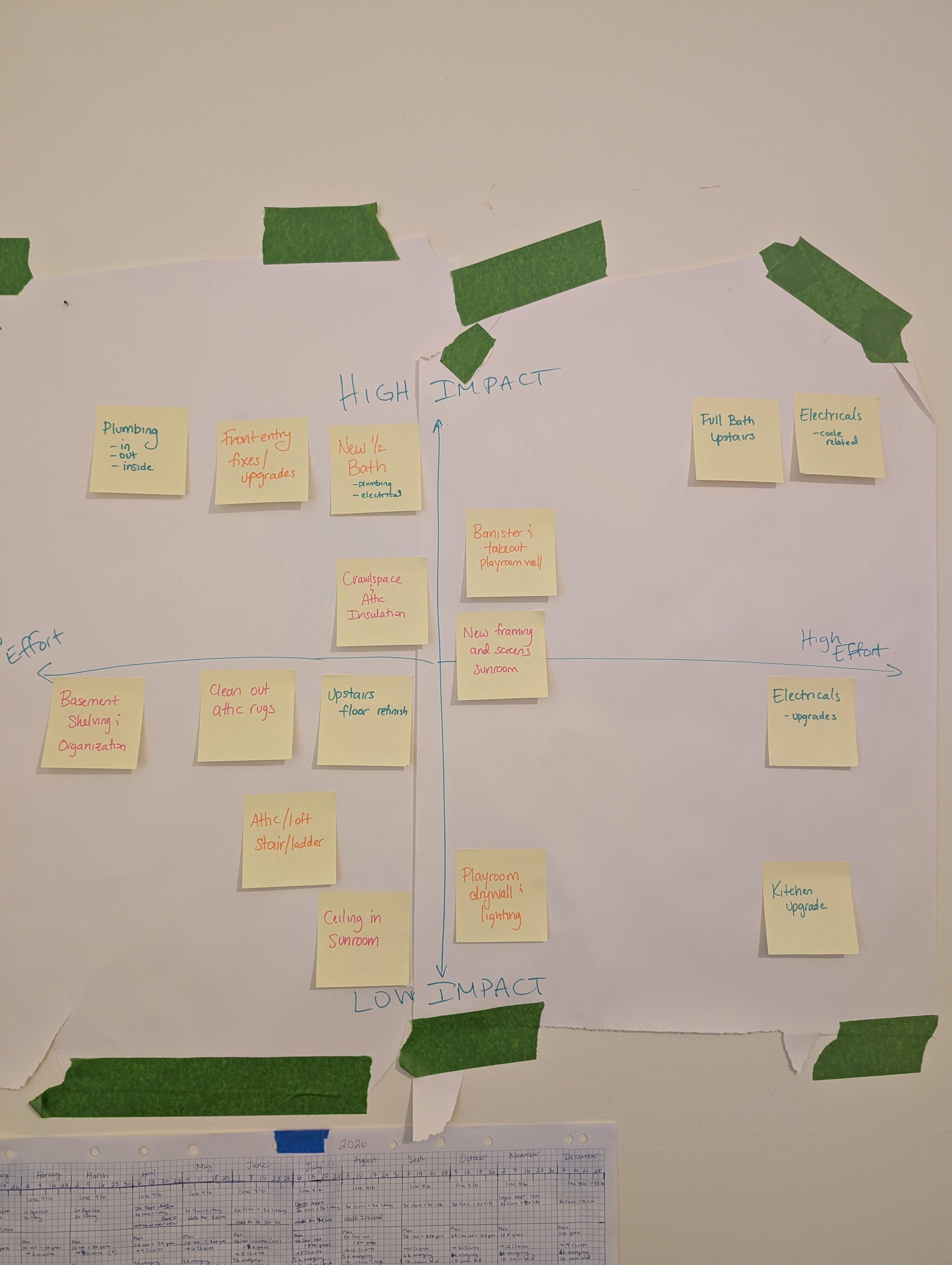
It took maybe twenty-five minutes. And when I looked at it, I could breathe.
Not because the list got shorter - it didn’t. But because the ticker tape finally had somewhere to go. Every project that had been looping through my brain was now stuck to a wall in my office, color-coded and positioned relative to everything else. The scroll stopped. The noise dropped. I could think again.
*If you’re interested in HOW to do this, I made a companion piece, video and text:
Build Your Own Board: A Practical Guide to Prioritization Matrices

Thank you to everyone who tuned into my live video! Now, let’s dig into what we talked about!

Here is what I saw that I couldn’t see before: the roof had to go first. Not because it was the most expensive (it was) or the most dramatic (it’s pretty dramatic though, black trim!), but because it sat upstream of everything else. You can’t properly insulate the attic until the roof is sound. You can’t finish the second-floor rooms until the attic insulation is done. The roof was the constraint. The thing that, if I didn’t do it first, would make everything else harder or pointless.

And that cascading logic revealed something else: once the attic insulation was scheduled, there was a natural window to build a cubby for my girls’ room; a pink post-it, total DIY, something I could do with my own hands while the bigger projects moved through their timelines. A small, satisfying project that I never would have identified as “next” if I’d been staring at a to-do list. But on the matrix, it was obvious.
The matrix also forced me to think about the contractor jobs differently. Not just “what’s most urgent” but “what’s the impact on my family while it’s happening?” The plumbing work, for instance, is disruptive but manageable - lower impact to daily life. The electrical rewiring, though? That’s two weeks of intermittent power and serious cleanup. Which means it needs to coincide with me taking the kids somewhere else for two weeks. That’s not a construction decision. That’s a logistics decision. And it’s the kind of thing you only see when you zoom out far enough to look at the whole board.

I’ve been in this exact spot before, just not at home. A year ago, my boss left for another company, and a post-merger integration project landed on my lap overnight. I went from supporting her to running integration workstreams across six different groups, each with their own people, processes, and tech stacks. The complexity was staggering. Enough to drown me.
The only way I got through it was to build a matrix, put it on the wall, and review it at the start of every weekly standup. It became my compass. Not a to-do list, a decision-making tool. Every week, I’d look at the board and ask: what’s moved? What’s blocked? What just became urgent because something else shifted? The projects didn’t get simpler, but our ability to navigate them did.
My house matrix works the same way. It’s not a checklist I’ll complete and throw away. It’s a living document. Post-its that move as priorities shift, new ones that get added when the next surprise inevitably arrives, old ones that get peeled off and tossed when a project is done. It’s the big picture, always visible, always current.
I think the reason I resisted making it for so long is that part of me believed home projects shouldn’t need a management framework. This is just a house. It’s just life. You should be able to keep track of it in your head, or in a notes app, or on a list stuck to the fridge.
But you can’t. Not when the scope is this big and the variables are this interconnected and the stakes include your family’s comfort and your savings account and your sanity. The same brain that would never try to run a six-workstream integration from memory was somehow trying to run a whole-house renovation from a ticker tape.
The post-its are still on my wall, and probably will be for a few years. The cubby is built and I have a video to prove it. And last weekend, for the first time since we moved in, I started a project without that nagging feeling that I should be doing something else instead.

The ticker tape is quiet. Not because the list got shorter. Because the list finally has a home.
Have you ever used an Eisenhower Matrix at work or home? Tell me about it in the comments! I’d love to hear from you.

Kate Vanness-Kandoth spent 18 years in life sciences operations before realizing her ops brain was never going to stay at the office. She writes Sorted State, a weekly newsletter about systems thinking for real life.
isn't it so interesting once we get the "ticker tape" out of our head ( I too am visual) and in front of us calm and solutions find their way in...looking forward to the updates as your projects progress